
- Details
EP5
BANG-DOU HUANG
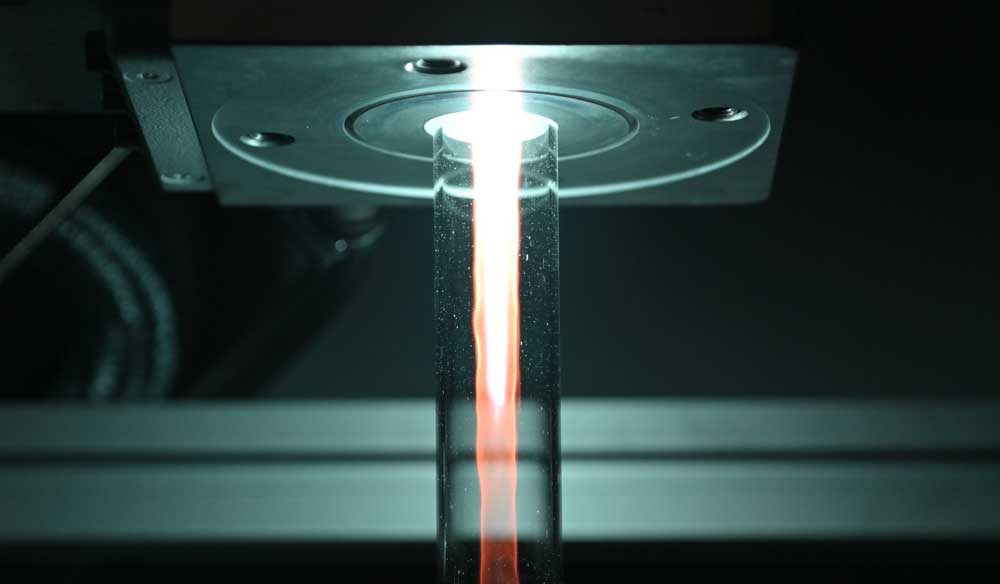
Bang-Dou Huang from Tsinghua University, Haidian, Beijing, China will work with Prof. Dr. Uwe Czarnetzki (Experimental Physics V) from October 1, 2015 to June 30, 2016 on a China Fellowship. Bang-Dou Huang is currently doing his PhD under Prof. Yi-Kang Pu at Tsinghua University in Beijing, with whom a close collaboration has existed for some time. The six-month stay is made possible by scholarship from his home university. Mr. Huang is investigating the propagation of ns-pulsed ionization waves in dielectric waveguides and has brought extensive experimental equipment to Bochum for this purpose. On the other hand, he is learning the technique of electric field measurement using four-wave mixing through collaboration with Patrick Böhm. In addition, he is working with Dr. Emile Carbon on ns-pulsed discharges in water.
- Details
TP1
PROF. RICHARD SYDORA
In September 2015, Prof. Dr. Richard Sydora from the University of Alberta, Canada, will again be a guest in Bochum with Dr. Jürgen Dreher (Theoretical Physics I).
- Details
DR. VOLKER SCHULZ-VON DER GATHEN AM GREMI
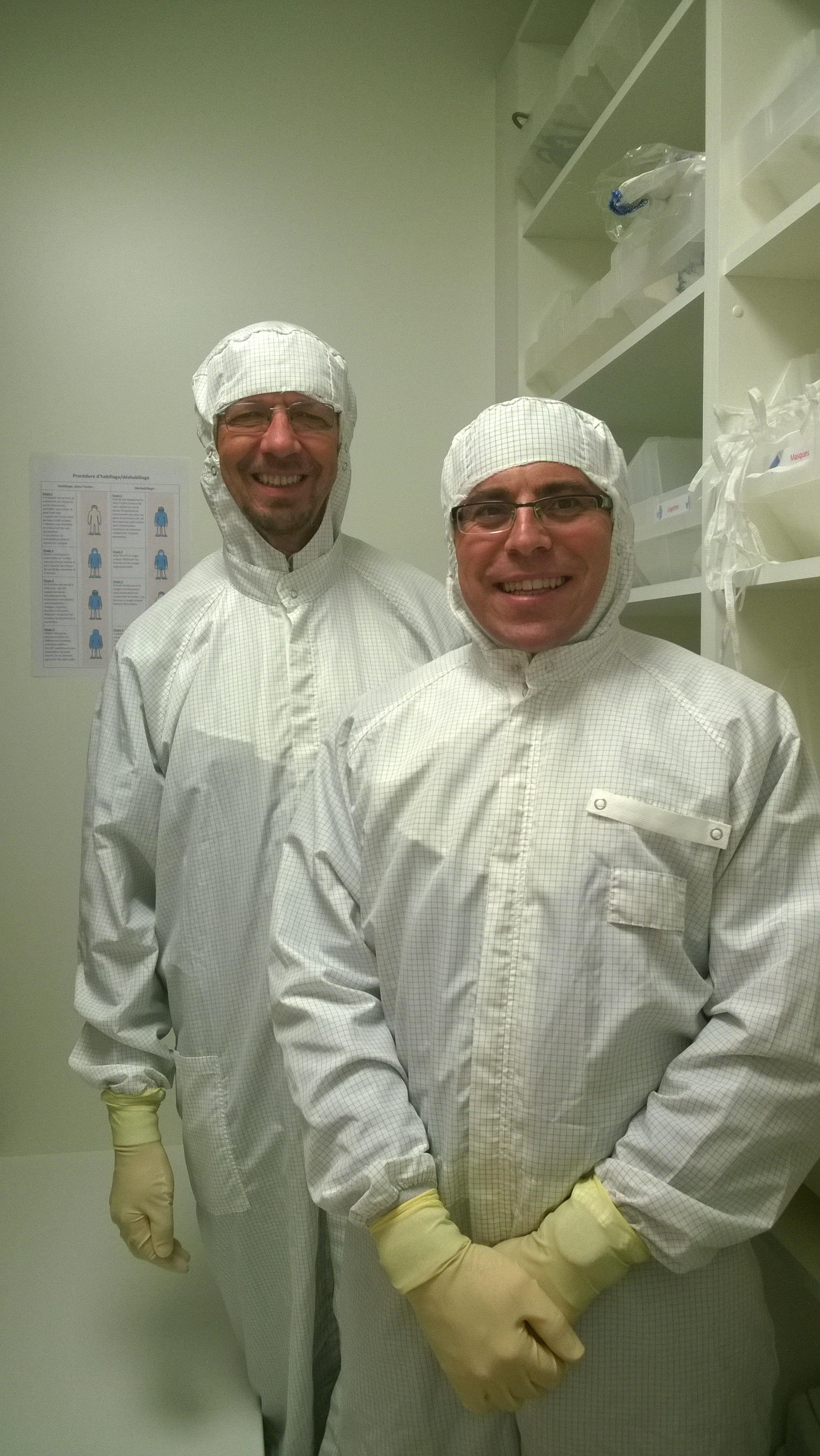 Im Rahmen des PROCOPE-Projektes "CoSi2Me" besuchte Dr. Volker Schulz-von der Gathen den Kooperationspartner Dr. Remi Dussart am GREMI in Orléans, Frankreich. In der Zeit vom 14.-19.09. wurden für gemeinsame Untersuchungen neuartige Arrays präpariert und untersucht. Zum Abschluss wurden Arbeiten des innerhalb der Forschergruppe FOR1123 untersuchten selbst-pulsenden Mikro-Plasmajets im Instituts-Seminar vorgestellt. Das Bild zeigt Volke Schulz-von der Gathen und Remi Dussart beim Übergang in den Reinraum des GREMI zur Präparation der neuen Mikro-Plasmarrays.
- link to GREMI
- Details
DR. ANTE HECIMOVIC VISITED MONS
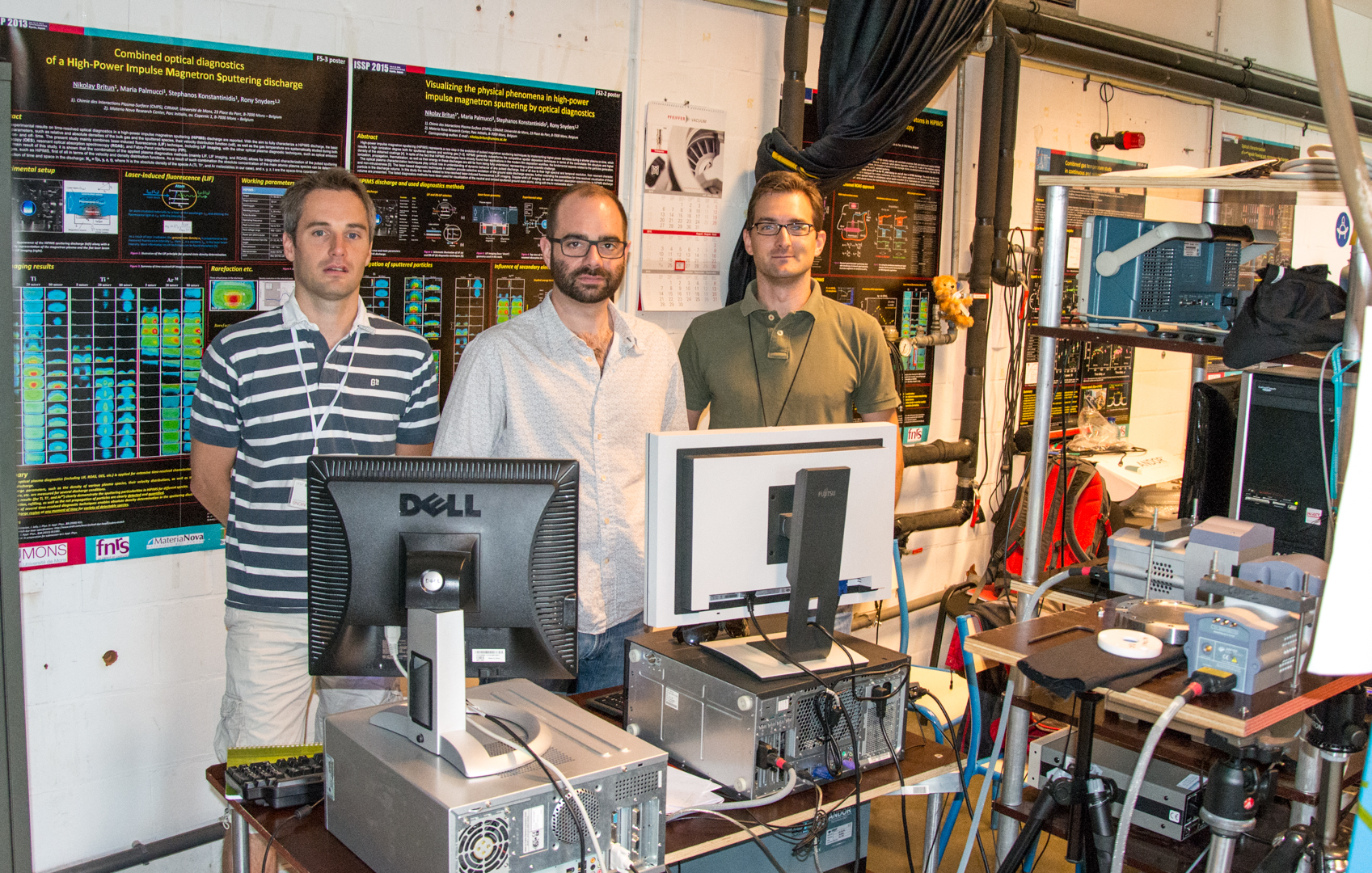 Postdoc Dr. Ante Hecimovic visited Mons in period August 20th-27th, 2015 within the frame of a joint collaboration with Dr. Nikolay Britun and Dr. Stephanos Konstantinidis from University of Mons, Belgium. The focus of collaboration is to expand understanding of physics behind the plasma inhomogeneities, i.e. spokes, in a HiPIMS discharge.
- Details
EP5
MARC VAN DER SCHANS
Marc van der Schans from the Department of Applied Physics, Elementary Processes in Gas discharges (EPG) at TU Eindhoven (Netherlands) will be visiting PhD student Patrick Böhm (Experimental Physics V) from 01-09 September 2015 to complete the measurements of the meeting from 27-31 July 2015. The planned goal of the cooperation, the application of the electric field measurement technique, which is further developed by Patrick Böhm in the context of his PhD thesis at the Ruhr-University, at Marc van der Schans' was extended by some measurement series after optimization of both setups. Due to the success of this cooperation, which provided more than just a "proof of concept" after the first week, there is nothing standing in the way of setting up a corresponding setup for the electric field measurement technique, which is currently only represented in one other group worldwide and is also known as "E-CARS", at the TU Eindhoven.
- Details
TP4
ICECUBE SUMMER RESEARCH EXPERIENCE WITH RESEARCHERS AT RUHR UNIVERSITÄT BOCHUM
International Research Experiences for Students (IRES) is a program funded by the National Science Foundation to support active participation of US undergraduates in international research projects. Laura Lusardi from New Richmond, WI, and Kelsey Kolell from Fond du Lac, WI, participated in the IRES program through UW–River Falls to work on IceCube research for the summer.
We are both third-year undergraduate students, studying physics at the University of Wisconsin–River Falls. This summer, we had the wonderful opportunity to travel to Germany through IRES to work with IceCube researchers. Even though we both ended up attending the same university, we took wildly different paths to get here.
Kelsey:
Going into my junior year of high school, I had every intention of majoring in chemistry once I got to college. This quickly changed after I took a physics class and fell in love with the subject. I had a great teacher who was really enthusiastic about physics and wanted her students to love it as much as she did. I changed direction and started to investigate colleges for studying physics. My high school teacher recommended that I look into where she earned her masters in physics, which is how I ended up studying physics and math at the UW–River Falls.
Laura:
Ever since I was a child, I've had a keen interest in astronomy. My interest piqued as I grew older, and I knew that astrophysics was what I wanted to pursue in college. Aside from UW–River Falls' phenomenal physics program, its involvement with the IceCube project was one of my greatest motivations for attending school there. I had hoped to get involved with the project during the school year, but the process actually began before I even started my first year. It was all thanks to our professor, Dr. Surujhdeo Seunarine. He was on a committee for a scholarship that I was applying for, and during that interview I expressed my interest in astrophysics. It was also during this time that I met Kelsey, who turned out to be one of my colleagues and best friends. Later that winter, when applications were being accepted for the IceCube summer internship, he remembered my interest and advised both of us to submit an application.
Kelsey:
When I came to River Falls, I had neither heard of the IceCube project nor had any knowledge of particle astrophysics. It just so happened that my advisor was Dr. Seunarine. Once he heard that I wanted to go into research, he told me about the project and about the chance to work on it over the summer.
We were unsure whether we would get into the program due to our lack of experience, but we were both extremely surprised to find that we had in fact been accepted! This was the beginning of a spectacular year working with each other and IceCube. During our ten weeks abroad, we worked with two PhD students, Fabian Bos and Sebastian Schöneberg, at the Ruhr Universität Bochum.
Laura:
I worked with Fabian on calibration of the detector using sun and moon shadows. Although IceCube's main goal is to detect high-energy neutrinos, it is important to make sure that we can also use it to see the sun and the moon. IceCube may be a telescope, but it doesn't have a lens through which to look, so we have to utilize a different method to see these celestial bodies. Both the sun and the moon create “shadows” by blocking incoming cosmic rays, which we see as a deficit of these cosmic rays within the detector. This information is then used as a calibration tool as well as to improve the angular resolution of the detector itself.
Over the course of the summer, I worked on improving my programming skills while learning about the different aspects of the project. I focused on two distinct analyses used in calculating cosmic ray deficits. I learned how use the different tools for coding, how to pull and process the IceCube data, and how to write and run the programs that generate the plots. Near the end of the summer, I was able to write my own programs and even improve upon some of the existing ones to generate new plots of the shadows.
Kelsey:
I worked with Sebastian on simulation of atmospheric neutrinos and muons. The goal for Sebastian’s project is to create simulations of the atmospheric neutrino flux at low energies. When cosmic ray particles enter the atmosphere, they interact with other particles creating a shower of secondary particles. With high-energy particles, the shower of secondary particles follows the same path as the primary particle, but for particles at lower energies, the showers branch out, like a cone of secondary particles, which casts a ring on the surface of the Earth. Each of these rings has a different percentage of secondary particles, some of which may hit the detector even if the path from the primary particle would have missed it and vice versa. My job was to figure out how many of the secondary particles would hit the detector at different angles. To do this, I made a lot of triangles and did a lot of trigonometry. Then, I was able to develop a procedure to find how much of the detector was being hit with the secondary particles. This is important, because if we can figure out how to account for the geometry without actually simulating it, we can save a lot of computing processing time.
By the end of the summer, we both made a lot of progress. Not only did we learn a lot about programming and physics, but more importantly we learned about working with graduate students and communicating with others about our work, all the while navigating a foreign country. It has been a truly remarkable summer. We have both learned so much during our time in Germany, met so many wonderful people, and made lots of new friends. This summer has opened our eyes to what it is really like to work in physics. We will both be able to use all the experiences that we gained this summer to help us achieve our dreams of becoming research physicists.
Photo (c) IceCube: Kelsey, Laura, Sebastian, and Fabian at the Ruhr Universität Bochum.
- Details
EP5
DR. AHMED M. HALA
Dr. Ahmed M. Hala is a Research Assistant Professor at the Plasma Physics Group of the Materials Science Research Institute of King Abdulaziz City for Science and Technology - KACST in Riyadh, Saudi Arabia. Dr. Hala will be a guest of Prof. Dr. Uwe Czarnetzki at the Chair of Plasma and Atomic Physics (Experimental Physics V) from 31.08.-04.09.2015.
- Details
TP4
SIYAO XU
Siyao Xu from Peking University, China, will give a talk on "Damping of MHD turbulence in partially ionized media" on September 2, 2015 as part of the Space and Astrophysics Seminar. The talk has been held NB 7/67 at 10:15 am. Those interested are welcome to attend!
Siyao Xu is a guest at the Institute of Theoretical Physics IV in August and September.
- Details
EP2
ATTA UL HAQ
PhD student Atta Ul Haq from the University of Ulster (UK) is visiting the Chair of Experimental Physics II for two and a half months (14.9.-30.11.). In the framework of his RAPID project "Microplasma-based synthesis of composite semiconducting nanoparticles" he is working together with Master student Philip Lucke.
- Details
TET
ASST. PROF. DR. VASCO GUERRA
Asst. Prof. Dr. Vasco Guerra from IST Lisboa, Portugal, will visit Dr. Efe Kemaneci from TET on September 3rd. His talk about "Kinetic modelling of microwave discharges in O2-containing mixtures" is at 11:00 am (ID 04/413).
Everybody interested is welcome to join!
Abstract: A self-consistent kinetic model is developed in order to study the elementary processes occurring in surfacewave microwave discharges in pure O2 and in the mixtures O2-Ar, O2-N2 and O2-N2-Ar. The theoretical formulation is based on the solution of a system of 0-D rate balance equations for the dominant neutral and charged species, coupled to the homogeneous electron
Boltzmann equation and to the quasi-neutrality condition, allowing the self-consistent determination of the sustaining reduced electric field E/N. The model is used to investigate different phenomena, such as dissociation in O2 discharges, production of O2(a) and UV emitting species, or the formation of NO and O3 molecules. The extension of the model to situations of
small-diameters / low-pressures, where the kinetics is strongly dominated by electron-impact collisions and wall interactions, is briefly discussed.
- Details
TP4
PETER H. YOON
Peter H. Yoon from the University of Maryland - Institute for Physical Science and Technology - USA, has received a "VIP Grant of the Reseach School PLUS". He will spend the next three years at the Ruhr-Universität Bochum, from which especially the PhD students will benefit (international enrichment of the "graduate education").