
- Details
European Summer School: 9.-16.10.2010
15. European Summer School, Physikzentrum Bad Honnef, 9.-16. Oktober 2010
“Low Temperature Plasma Physics: Basics and Applications” (9.-14. Oktober) und
“Atmospheric Pressure Plasmas" (Masterclass, 15./16. Oktober)
Weitere Informationen finden Sie hier.
- Details
Leuven
15.10.2010 - Dr. Marian Lazar at Katholieke Universiteit Leuven
From 11th to 12th of October, 2010, Dr. Marian Lazar, Institut für Theoretische Physik IV visited Katholieke Universiteit Leuven, Belgium. He was the guest of Prof. Stefaan Poedts from the Center of Plasma Astrophysics, one of the leading European centers actively involved in international projects of research in astrophyics and solar-terrestrial physics. He discussed a series of results from joint activities, and new research directions in the solar wind turbulence, kinetic instabilities of kappa-distributed plasmas, and their effects on the particle transport in interplanetary space, in the context of the new satellite measurement capabilities.
- Details
Princeton
12.10.2010 - Philipp Kempkes am Princeton Plasma Physics Labor
Vom 16.09.2010 bis 08.10.2010 besuchte Dr. Philipp Kempkes (AG Laser- und Plasmaphysik) Dr. Masaaki Yamada am Princeton Plasma Physics Laboratory, um einen Einblick in die Arbeit des Teams von Dr. Yamada am Magnetic Reconnection Experiment (MRX) zu erhalten. Schwerpunkt war die Einarbeitung in die Erfassung und Auswertung von dreidimensionalen
Magnetfeldmessungen mithilfe eines Vielkanal-Erfassungssystems. Von weiterem Interesse waren die an MRX durchgeführten Untersuchungen von verdrehten magnetischen Flussröhren. Diese sind in ihrer Geometrie den am FlareLab-Experiment in Bochum erzeugten sehr ähnlich, entwickeln sich allerdings auf längeren Zeitskalen, was einen Vergleich der Dynamik besonders interessant macht.
Der Besuch fand im Rahmen eines International Cooperation Agreements zwischen der Forschergruppe 1048 und dem Center for Magnetic Self-Organization (CMSO) statt und wurde durch das RD ermöglicht. Er stellt den Beginn eines längerfristig angestrebten Austausches zwischen der Gruppe von Dr. Yamada und der AG Laser- und Plasmaphysik dar.
- Details
12.10.2010 - Dr. Ilija Stefanović zu Gast am LATMOS
 Am 11.10.2010 war Dr.-Ing. Ilija Stefanović zu Gast am LATMOS (Französisch für Labor für die Atmosphäre, Umwelt und Weltraumforschung). Der Anlass war sein Seminar „Dust in Laboratory Plasmas and Astrophysics“, in dem er über die Ergebnisse berichtete, die im Rahmen des durch DFG gefördertes Projekts WI 1700/3-1 „Tailored production of nanoparticles in nonequilibrium plasmas“ erworben wurden. Dieses Projekt ist im Research Department „Plasma with Complex Interactions“ angesiedelt. Die weiteren Mitarbeiter des Projekts sind Dipl.-Ing. Brankica Sikimić, Doktorandin, und Prof. Dr. Jörg Winter. Während Dr. Stefanovićs Besuchs hat er mit unseren französischen Kollegen Prof. Dr. Guy Cernogora, Prof. Dr. Natalie Carrasco und Dipl.-Phys. Thomas Gautier über die Vorbereitung des Antrags eines DAAD Austauschprojektes zwischen unseren Labors gesprochen.
- Details
RD-Plasma auf der GEC 2010 in Paris
The Research Department “Plasmas with Complex Interactions” enabled the participation of Dr. Tim Baloniak, Jun.-Prof. Jan Benedikt, Prof. Ralf Peter Brinkmann, Dr. Marc Böke, Prof. Uwe Czarnetzki, Dirk Ellerweg, Dr. Denis Eremin, Benedikt Niermann, Marina Prenzel, Priyadarshini Rajesekaran, Rüdiger Reuter, Cornelia Ruhrmann, Dr. Volker Schulz-von der Gathen, Dr. Ilija Stefanovic, Michael Westermeier, and Prof. Jörg Winter in the 63rd Gaseous Electronics Conference (GEC 2010) in Paris between October 4th and 8th 2010. The GEC is a yearly platform for presenting recent results in the area of low temperature plasma physics, and this year, showing in various fields contributions by the RD groups. The RD Plasma was represented with more than 40 talks or poster contributions showing particularly recent developments in the diagnostics, applications and modeling of micro-discharges.
- Details
Computational Plasma Physics at the RUB and in Copenhagen
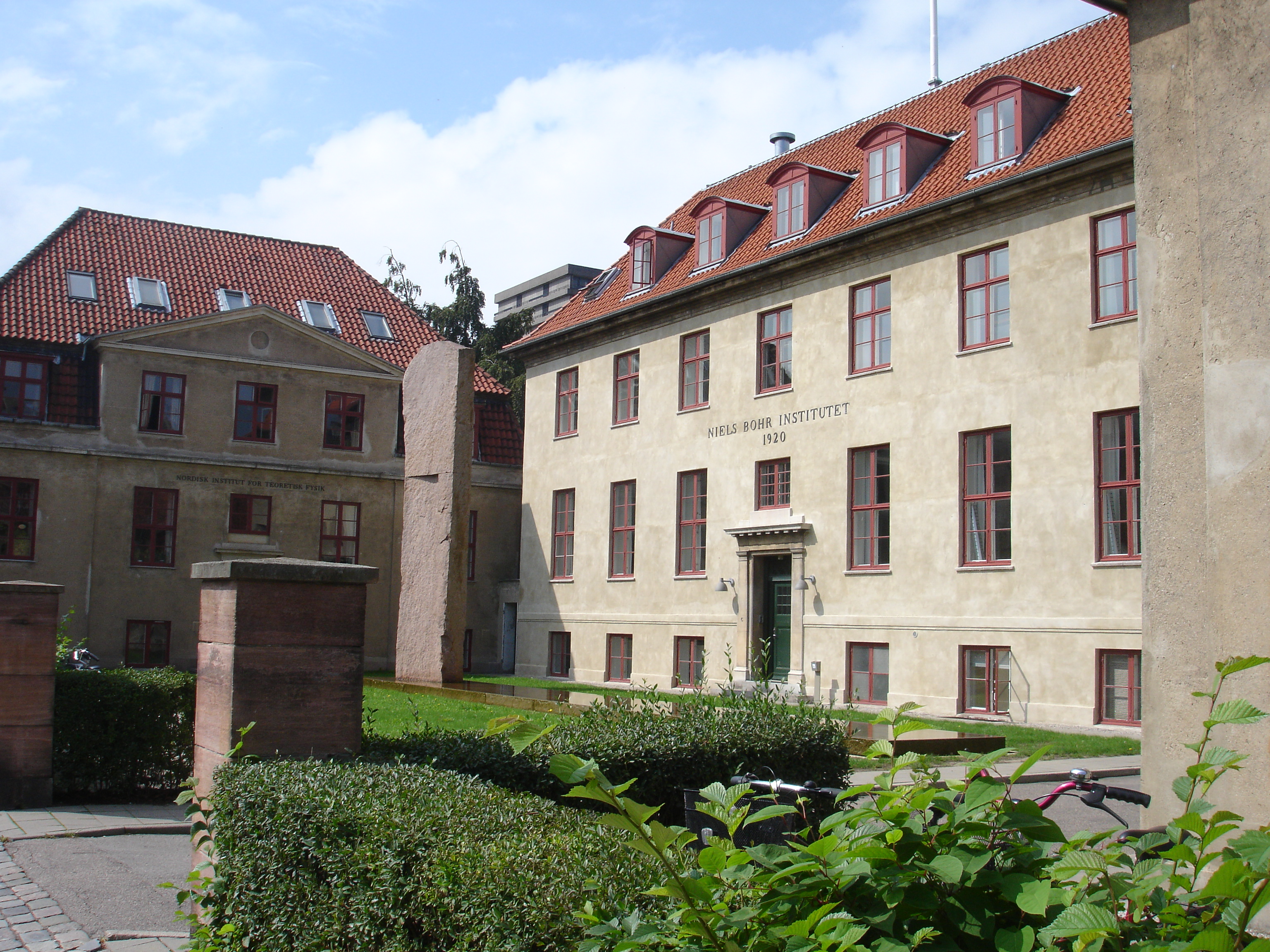
From 22.09. to 24.09.2010 an informal meeting on Computational Plasma Physics between the working group of Prof. Dr. Rainer Grauer and Prof. Dr. Åke Nordlund (Computational Astrophysics) has been held in Copenhagen at the Niels Bohr Institute. In particular, the progress of the use of graphics card clusters in this field was discussed.
On this occasion, Martin Rieke gave an introductory talk on CUDA and solving 2D EMHD equations on graphics cards. Dr. Christian Schwarz reported on his new framework cudaHYPE and its use in parallel solving of 3D MHD equations on a GPU cluster. From the Copenhagen group, Dr. Troels Haugbølle told us about his experiences with PIC (Particle in Cell) simulations on graphics cards.
In Prof. Grauer's talk, he explained strategies for coupling kinetic and fluid systems (Vlasov/MHD coupling). Last in the lecture series, Prof. Nordlund reported on new simulation results in the field of solar physics.
- Details
27.09.2010 - Dr. Sabrina Casanovas Reise zur 32. Erice School
Astrophysical shocks, for instance in supernova remnants (SNRs), are able to accelerate particles to extremely high energies. The leading acceleration mechanism is diffusive shock acceleration. Its efficiency critically depends on the injection of thermal plasma into acceleration which takes place at the subshock of the collisionless shock structure.
The magneto-hydrodynamical (MHD) turbulence confines particles to the shock front controlling their maximum energy. Therefore, the study of the MHD turbulence in a compressive plasma near a shock is a key to understanding the entire process of particle acceleration. In other words the theory of shock acceleration is a new challenge in plasma physics.
Dr. Casanova was invited by the organizers to give an overview talk at the 32nd Erice School (September 16th - 24th, 2010). She held a lecture concerning the gamma ray emission from molecular clouds close to SNRs. In the talk, Dr. Casanova presented the acceleration of particles in the shell of SNRs as well as an investigation of the the gamma ray emission produced by the accelerated particles in the shell of the SNRs and in the vicinity of the SNRs. The latter is a powerful tool to probe the properties of the acceleration mechanism, such as the maximum acceleration energy. During the time of the school, Dr. Casanova participated in the open discussions taking place every day in the early afternoon.
- Details
International Conference on Plasma Medicine (ICPM-3)
The 3rd International Conference for Plasma Medicine has been held in Greifswald, Germany from 19th -24th September, 2010. Almost 200 plasma physics researchers, medical doctors, and people from industry have met there and discussed their work on five following topics: 1) plasma surface modification for biomedical application, 2) plasma sources for medicine, 3) medical aspects and results of plasma in use, 4) plasma cell and plasma tissue interaction, and 5) plasma based sterilization/decontamination. Plasma medicine is a new and rapidly growing research field with great potentials in the applications such as in-vivo treatment of wounds and infected tissues, plasma surgery, or plasma sterilization. The Research Department "Plasmas with Complax Interactions" enabled the visit of members from research teams of Prof. Peter Awakowicz (Fac. of Electrical Engineering and Information Technology), Prof. Achim von Keudell and Jun.-Prof. Jan Benedikt (Fac. of Physics and Astronomy) and Prof. Franz Narberhaus und Jun.-Prof. Julia Bandow (Fac. of Biology and Biotechnology), which are active in this field already for several years. The visitors from RUB have presented with four talks and two posters their results of plasma sterilization with low pressure and atmospheric pressure plasmas.
- Details
Dr. Enno Middelberg auf der Jahrestagung der VLBI Community in Manchester
Dr. Enno Middelberg works as a junior scientist at the Astronomical Institute of the Ruhr-University Bochum. His field of work is the investigation of radio sources with Very Long Baseline Interferomerty (VLBI) techniques. A significant fraction of these radio sources at cosmological distances are so-called active galactic nuclei (AGNs), i.e. black holes with collimated outflows of relative plasmas that act as accelerators for cosmic ray particles with the highest known energies. The study of such phenomena is considered the main focus of the astrophysical part of our RD. The work of Mr. Middelberg is therefore complementary to the work at LS TP4, where the theoretical description of the corresponding phenomena is in the foreground.
Applications of VLBI technology at the RUB are new and must be publicized accordingly so that the Ruhr-Universität Bochum is also perceived as a new location in the community. Since there is no other site in Germany outside of Bonn with users of VLBI, a RUB presence here is very significant.
In order to strengthen the international visibility of Dr. Middelberg accordingly, he attended the 10th European VLBI Network Symposium and the EVN Users Meeting "VLBI and the new generation of radio arrays" from September 20 to 24, 2010 with the support of the Research Department "Plasmas with Complex Interactions".
- Details
Jun.-Prof. Julia Becker & Martino Olivo: IceCube meeting in Brussels
Jun.-Prof. Julia Becker and her PhD student Martino Olivo participated in the IceCube meeting in Brussels (Belgium) from September 20-23, 2010. At the IceCube meeting, the progress of the experiment setup, detector simulations, analyses, and the physics underlying the experiment over the last six months was discussed. The IceCube collaboration meets 2 times a year to give the members of the collaboration the opportunity to exchange ideas. In particular, Martino Olivo was able to give a talk on "Gamma ray burst analysis with IceCube-79 data". Here, Mr. Olivo presented the status of his analysis, which he plans to perform with the current configuration of the IceCube detector. Currently IceCube has 79 detector strings, in the final configuration, which will be completed in February 2011, IceCube will consist of 86 detector strings.
Furthermore, a collaboration with Prof. Francis Halzen could be intensified at the conference. A possible publication on the topic "Cosmic rays from massive binary systems" was discussed at the IceCube meeting.
Furthermore, the interests of the Research Department within the IceCube collaboration could be represented at the meetings of the Collaboration Board by Jun-Prof Julia Becker.
Jun-Prof Julia Becker also participated in the meetings of the Publication Committee of the IceCube Collaboration, where upcoming publications within the IceCube Collaboration were discussed.
- Details
Jun.-Prof. Julia Becker bei der Tagung der Astronomischen Gesellschaft in Bonn
At the annual meeting of the Astronomische Gesellschaft in Bonn (September 13-17, 2010), astronomers active in Germany met to discuss the current state of research. A total of about 350 people participated in the meeting. In lectures the current state and future projects of astronomy were discussed. In particular, a poster on "Hadronic signatures from GRBs with extra components at high energies" was presented by the traveler. The physics of particle acceleration and interaction in the highly relativistic plasmas of Gamma Ray Bursts (GRBs) were discussed with a wide variety of scientists, such as Prof. Kowalski and Dr. Elsässer, at the meeting. Furthermore, the interests of the Research Department were represented at the meeting of the Council of Observatories on September 13.